USB-C 240W: What Does This Number Really Mean
240W, that won't speed up your phone's charging. What this number really changes, and how to know if you need it.

On product sheets, a USB-C cable often displays a wattage figure: 60 W, 100 W, 240 W. Many people infer that the most powerful cable will charge their phone faster. This is incorrect, and it's probably the most common misconception surrounding USB-C. Here's what this number means, and when it matters.
The cable does not determine charging speed
In USB-C charging, three elements communicate with each other: the charger, the cable, and the device. The power actually delivered is that of the weakest link. A 240 W cable connected to a 20 W charger will deliver 20 W. An iPhone that accepts a peak of 27 W will draw 27 W, whether the cable is rated 100 W or 240 W.
In other words: the wattage figure on a cable is a ceiling, not a promise. It indicates what the cable can pass without overheating, nothing more.
Where 240 W comes from
240 W corresponds to the USB Power Delivery 3.1 (EPR, Extended Power Range) revision published by the USB Implementers Forum in 2021. It increases the maximum voltage from 20 V to 48 V, i.e., 48 V × 5 A = 240 W. To support these 5 A, a cable must include an identification chip (e-marker) that declares its capability to the charger. Without this chip, charging automatically reverts to 3 A.
This is the real advantage of a cable certified for this power: it doesn't unlock anything, but it doesn't limit anything either. A cheap cable without an e-marker caps a laptop at 60 W even though its charger can provide 100 W.
Who really needs 240 W?
- A phone: no. Smartphones sold in Europe charge between 20 and 80 W depending on the model. A 100 W cable is more than sufficient, and a 240 W cable will not perform better.
- A laptop or a MacBook Pro: yes, if your charger exceeds 100 W. Otherwise, you'll lose fast charging without realizing it.
- A portable console, a USB-C powered screen, a docking station: often yes. These are the uses that currently go the highest.
What to look at instead
Three things matter more than the wattage for most people:
- Length. The longer a cable, the more it heats up and the more it loses. 1 m is enough for a desk, 2 m for a sofa or car.
- Data transfer speed. Power and data are separate. A 240 W cable can be limited to USB 2.0 (480 Mbit/s). If you're transferring video rushes, check the advertised data rate, not the watts.
- Connector strain relief. This is where 90% of cables die. An angled connector and braided sheath withstand being twisted against a wall or in a bag much better.
What we have in store
We sell two cables, and they meet two different needs.
The 240 W USB-C cable with angled connector (€14.90) is designed for sedentary use: desk, bedside table, workstation. The 90° connector prevents strain on the port's output, and the braided nylon sheath resists friction. The manufacturer announces USB PD compatibility up to 240 W.
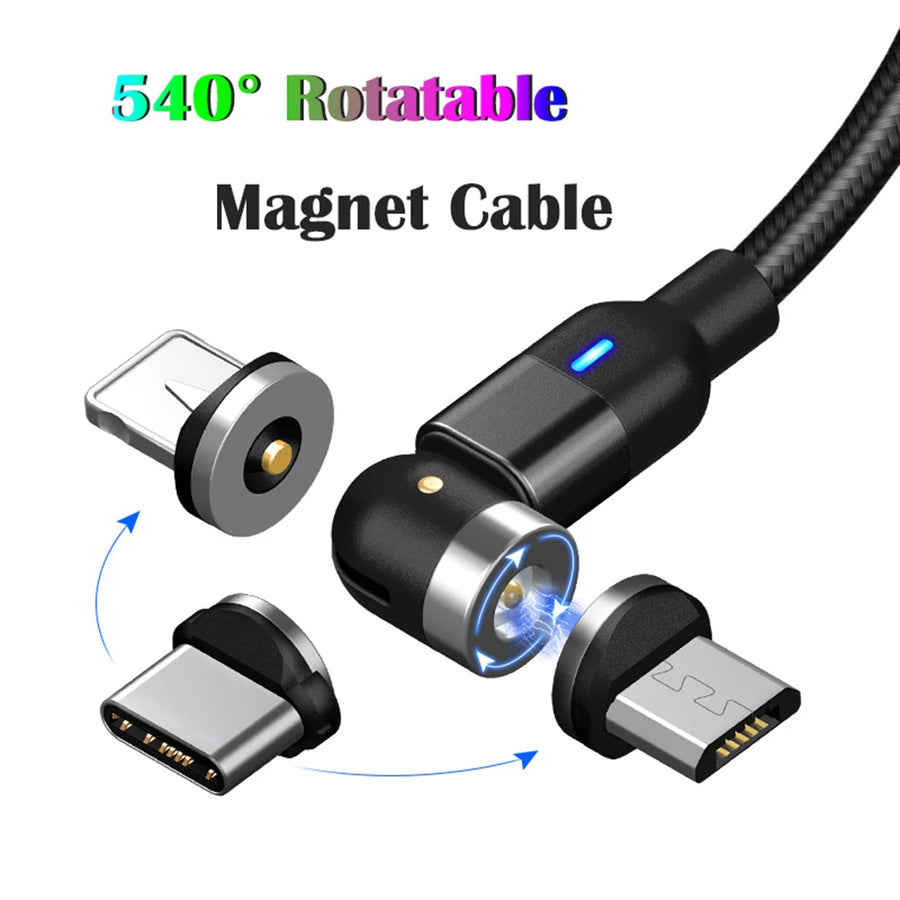
The magnetic charging cable with rotating head (€14.90) addresses another problem: plugging and unplugging twenty times a day, or juggling between USB-C, Micro-USB, and Lightning with a single cable. It is not designed for high power — it's a convenience cable, not a laptop cable.
Key takeaway
The wattage figure on a cable doesn't make anything faster. It merely prevents a charge that your charger and device can already handle from slowing down. If your charger is below 100 W, you can completely ignore this number and choose your cable based on length and durability.
The entire section is here: Charging & batteries.